

You can source the most exquisite Calacatta marble and specify the finest fluted walnut cabinetry, but if your kitchen is poorly lit, the entire investment falls flat. In luxury home architecture, illumination is never an afterthought; it is the foundational element that dictates both how a space functions and how it feels.
When clients search for premium kitchen lighting ideas, they often focus purely on the aesthetics of a statement chandelier. However, a truly contemporary kitchen demands an engineered approach to light. As open-concept layouts continue to dominate, the kitchen must seamlessly transition from a high-visibility prep station in the morning to an intimate, moody entertaining space by night.
Achieving this flawless transition relies on mastering three distinct lighting impacts:
- Ergonomic Functionality: Eliminating heavy shadows over cutting boards and active cooking zones to reduce eye strain and improve safety.
- Architectural Enhancement: Using concealed light washes to highlight the natural veining of stone countertops and the textural depth of custom timber facades.
- Atmospheric Control: Integrating automated dimming and scene-setting technology that instantly shifts the room’s energy for evening hosting.
Designing and executing this level of integrated illumination requires meticulous electrical planning. As the Best Interior Designers in Bangalore, The KariGhars approach lighting as a structural necessity rather than a decorative accessory. We ensure every fixture serves a precise purpose in a seamlessly automated ecosystem.
Before you commit to a cabinetry layout or final finishes, you must understand the architecture of light. Here is the definitive guide to engineering a perfectly illuminated luxury kitchen.
Key Points at a Glance
- The Luxury Trinity: A premium kitchen requires three distinct layers of light. Task lighting for precision, ambient lighting for volume, and accent lighting for architectural depth.
- Precision Tasking: Outdated puck lights are obsolete. Continuous LED channels and perfectly spaced island pendants eliminate shadows and prevent glare over work zones.
- Kinetic Integration: High-end modular kitchen lighting ideas rely on automation. Handle-less drawers and motorized cabinets feature sensors that illuminate strictly upon interaction.
- Architectural Illusions: Concealed toe-kick lighting and backlit translucent stone transform heavy islands into weightless, floating centerpieces during evening hours.
- Turnkey Execution: The KariGhars provides stress-free, end-to-end design and installation, managing all complex electrical engineering in-house with a zero-cost-escalation policy.
The Three Tiers of Luxury Illumination
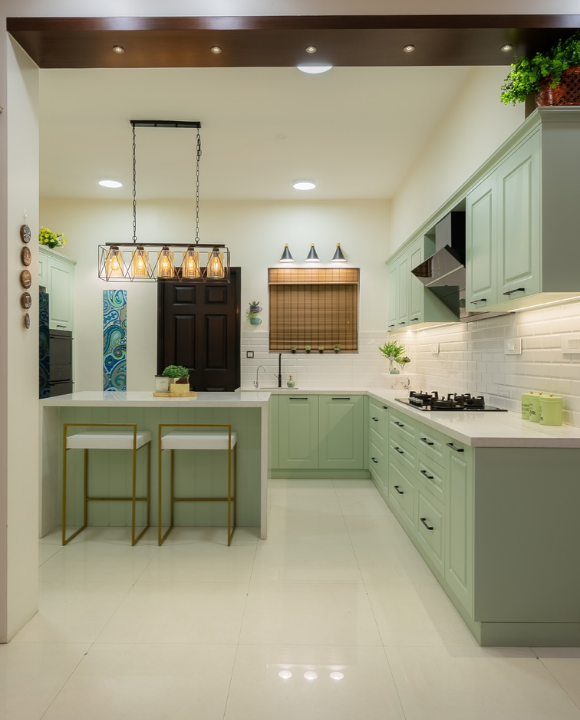
Mastering a luxury kitchen layout requires moving past the concept of a single, central ceiling light. A single light source casts harsh shadows exactly where you need visibility and strips the space of architectural depth. True interior lighting design relies on layering light across three distinct operational tiers: task, ambient, and accent lighting.
When these three layers are executed in unison, they create a balanced, visually wealthy environment that eliminates glare while providing optimal utility.
| THE LUXURY LIGHTING TRINITY |
| [ TASK LIGHTING ] ➔ Focus & Precision (Work Zones) |
| + |
| [ AMBIENT LIGHTING ] ➔ Volume & Warmth (General Space) |
| + |
| [ ACCENT LIGHTING ] ➔ Drama & Depth (Architecture) |
Understanding the Technical Tiers
To effectively implement these kitchen lighting ideas, each tier must be calibrated to its specific structural role, color temperature, and functional zone.
| Lighting Layer | Primary Objective | Placement Strategy | Ideal Technical Spec |
|---|---|---|---|
| Task Lighting | Provides high-intensity, focused visibility to eliminate shadows during food preparation. | Mounted under overhead cabinets, inside pantries, and precisely over the island. | 4000K (Neutral White) |
| Ambient Lighting | Softly fills the volume of the room to serve as the structural baseline of illumination. | Architectural coves, recessed downlights, and flush-mounted ceiling profiles. | 2700K to 3000K (Warm White) |
| Accent Lighting | Draws the eye to specific focal points, adding visual drama and architectural depth. | Recessed toe-kicks, backlit open shelving, and internal glass cabinet strips. | 2400K to 2700K (Very Warm) |
The Symbiosis of the Tiers
An elite kitchen ecosystem balances these layers through smart home automation, ensuring that no single light source dominates the room.
- The Foundation (Ambient): This tier establishes the overall brightness of the space, bouncing light off floors and walls to ensure you can safely navigate the kitchen. It acts as the visual canvas.
- The Precision (Task): This tier steps in exactly where the ambient light is blocked by your body or cabinetry. It focuses purely on the countertops, sink, and cooktop, acting as a functional tool.
- The Drama (Accent): This tier is pure theatre. It is used to sculpt the room after dark, highlighting expensive stone veining or making a heavy center island look as though it is floating above the floor.
The Professional Calibration is that you never mix static, high-kelvin cool white lights across all three tiers. A luxury home demands a thoughtful gradient. By keeping task lights slightly crisper and ambient or accent layers noticeably warmer, you can maintain maximum functionality at the countertops without making your kitchen feel like a clinical pharmacy.
Precision Task Lighting: Eliminating the Shadow Zones
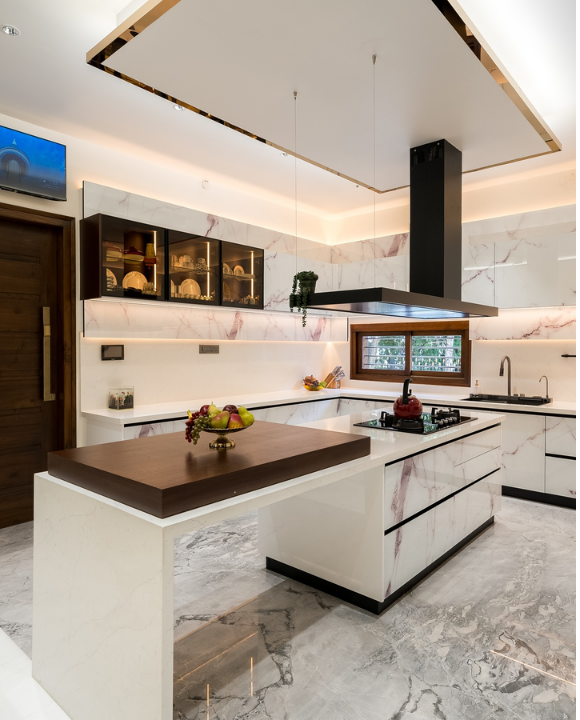
A common architectural failure in high-end kitchens is relying entirely on a grid of overhead recessed lights. When you stand at the counter to prep a meal, your body blocks the ceiling fixtures, instantly casting a hard, dark shadow directly over your cutting board. Precision task lighting solves this by bringing the light source below eye level.
When evaluating high-end Lighting ideas for kitchen workspaces, the focus must shift from how a fixture looks to the exact spread of its beam. The primary chef should never have to lean sideways to see what they are chopping.
To guarantee total visibility without glare, elite kitchen designs incorporate three specific task lighting solutions:
- Diffused Under-Cabinet Channels: Outdated puck lights create distinct hot spots and harsh reflections on glossy stone countertops. Modern luxury utilizes continuous aluminum channels fitted with frosted diffusers.
These profiles house high-density LED strips, casting an unbroken, even wash of light across the entire length of the counter.
- The Island Pendant Geometry: Pendants suspended over a kitchen island are often treated merely as decorative jewelry.
To function effectively as task lighting, they must follow strict spatial geometry. Pendants should hang exactly 30 to 36 inches above the countertop surface. Furthermore, they must be spaced closely enough so that their individual light cones overlap, preventing any dark gaps across the island’s surface.
- Directional Sink Illumination: The primary prep sink requires dedicated, high-intensity lighting.
A fixture with a High Color Rendering Index (CRI of 90 or above) is strictly required here. High CRI lighting ensures that the color of fresh produce and meats is accurately represented, allowing for absolute culinary precision.
Task lighting must be entirely concealed from the seated sightline.
If guests seated at the dining table can see the actual LED diodes mounted under your cabinets, the installation has failed. We recess our LED channels deeply into a custom architectural lip built into the bottom of the cabinetry, ensuring the light hits the counter, never the eye.
Elevating the Space with Smart Modular Integration
The intersection of bespoke cabinetry and invisible technology is exactly where a kitchen transitions from premium to ultra-luxury.
In 2026, high-end modular kitchen lighting ideas are entirely kinetic. Your lighting should not wait for a physical switch to be flipped; it must anticipate your movements and respond seamlessly as you interact with the space.
Integrating smart sensors directly into the cabinetry framework entirely changes how you navigate the kitchen. By embedding micro-LEDs and motion technology into the actual joinery, we eliminate dark corners and streamline the cooking experience.
The Mechanics of Kinetic Illumination
- Motion-Activated Internal Architecture: Finding a specific spice jar in a deep drawer should never require turning on the main ceiling lights.
Elite modular systems feature handle-less, push-to-open drawers equipped with magnetic proximity sensors. The moment the drawer glides open, internal micro-LED strips instantly illuminate the contents, turning off silently the second it closes.
- The Automated Walk-In Pantry: A luxury pantry is a room unto itself, often tucked away from natural light. We wire these spaces with passive infrared (PIR) sensors.
As you step through the threshold carrying heavy groceries, the lighting gradually ramps up to 100% brightness, illuminating floor-to-ceiling shelving without a single button press.
- Motorized Synchronicity: For upper-tier storage, motorized drop-down cabinets are becoming standard.
We integrate the lighting controllers directly into the motor’s logic board. As the cabinet lowers to eye level, a dedicated light wash activates to display your stemware or heavy stand mixers, turning a functional storage unit into a dynamic display.
- The Centralized Ecosystem: True luxury means completely eliminating wall clutter. We remove banks of ugly plastic switches and wire your entire modular lighting system directly into your home’s central automation hub (such as Lutron or KNX). This allows your kitchen cabinetry to sync perfectly with your living room lighting, all controlled via a single sleek keypad or your smartphone.
By weaving sensor technology directly into the wood and stone, the kitchen ceases to be a static room. It becomes an intuitive environment that actively assists you while you prep, cook, and host.
Architectural Accents: The Floating Illusion
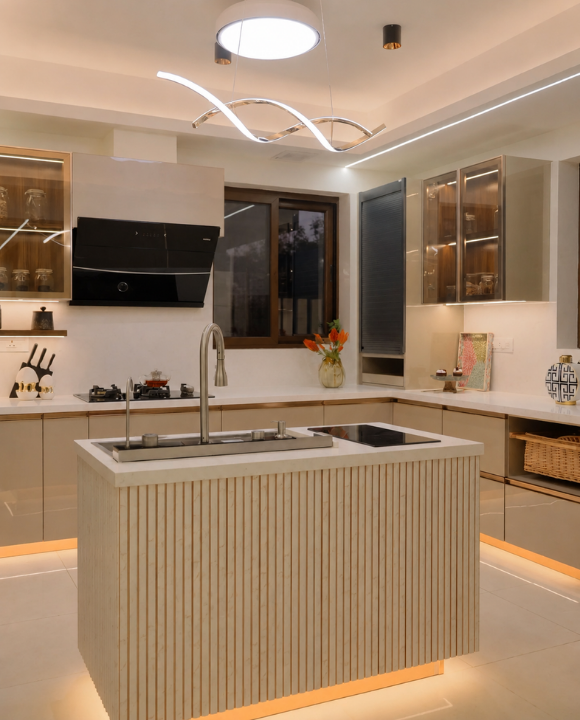
As evening approaches, the functional demands of the kitchen subside, and the space must transition into an atmospheric lounge.
This is where architectural accent lighting takes command. In 2026, the prevailing trend in luxury interiors is to use light to manipulate the physical perception of heavy architectural elements.
Instead of simply illuminating a room, we use concealed lighting to create depth, highlight premium materials, and introduce a profound sense of weightlessness.
The Mechanics of the Floating Illusion
The most striking visual technique in contemporary kitchen design is the floating island effect, achieved through precisely engineered toe-kick lighting. By installing continuous LED profiles at the very base of the cabinetry, we sever the visual connection between heavy stone installations and the floor.
- Diffused Beam Spreads: To achieve a flawless floating effect, the light must wash evenly across the floor without reflecting individual LED diodes on polished tiles. We utilize specialized aluminum extrusions with 45-degree angled lenses to push the light outward smoothly.
- Biophilic Warmth: The color temperature here is critical. Moving away from stark whites, we specify warm, amber-toned LEDs (2400K to 2700K) that mimic the calming, restorative essence of nature, a direct nod to the biophilic design trends shaping luxury homes today.
- Wayfinding and Safety: Beyond sheer aesthetics, this low-level illumination serves as an intuitive nightlight. It allows homeowners to navigate the kitchen for a late-night glass of water without jarring their eyes with overhead fixtures.
| Desired Visual Effect | Beam Angle | Installation Profile | Ideal Color Temp |
|---|---|---|---|
| Subtle Float | Narrow (30°) | Straight down-cast extrusion | 2700K (Warm White) |
| Dramatic Wash | Wide (120°) | 45° angled corner extrusion | 2400K (Amber Glow) |
| Colored Ambiance | Variable | Smart RGBW enclosed channel | Tunable (App Controlled) |
Illuminating Vertical Space: Backlit Stone and Glass
While toe-kick lighting grounds the space, vertical accent lighting draws the eye upward, transforming storage into a curated gallery display.
- Backlit Natural Stone: One of the most opulent applications of light is backlighting translucent stone. By installing ultra-thin LED panels behind slabs of onyx or heavily veined quartzite on the backsplash or island fascia, the stone itself becomes the light source, radiating a warm, organic glow.
- The Glass Cabinet Gallery: Solid wood upper cabinets can make a room feel enclosed. We break up these heavy sightlines with bronze-tinted or fluted glass-front cabinetry. By recessing micro-LED strips vertically along the internal cabinet hinges, we create a soft, ambient showcase for fine stemware and ceramics.
- Living Room Influences: The kitchen is adopting the decorative sensibilities of the living room. We are increasingly integrating backlit open shelving, sculptural wall sconces, and even dedicated architectural table lamps onto the island to soften the room and make it feel truly lived-in.
| Feature | Illumination Strategy | Visual Impact |
|---|---|---|
| Glass-Front Cabinets | Vertical internal micro-LED strips | Highlights crystal and ceramics without glaring outward |
| Floating Shelves | Recessed underside LED channels | Casts a soft glow on decorative objects placed below |
| Translucent Backsplash | Evenly spaced flat LED backing sheets | Turns natural stone veins into a glowing art installation |
Treating light as a distinct architectural material. The KariGhars ensures your kitchen remains breathtaking long after the cooking is finished.
Why Choose The KariGhars? Flawless Electrical Execution
Executing a three-tiered, automated lighting system is a highly complex engineering task. It involves motorized cabinetry, centralized smart home integration, and flawless internal wiring. Relying on independent contractors to manage these intersecting systems frequently results in misaligned sensors, exposed wiring, and delayed timelines.
As the premier Interior Designers in Bangalore, The KariGhars eliminates this friction. We treat lighting design and electrical engineering as a single, unified phase of construction. Our turnkey approach guarantees that the vision on the blueprint is exactly what gets built.
- In-House Electrical Engineering: We do not outsource your smart home integration. Our dedicated internal engineers map every circuit, specify every driver, and program every automation hub. This ensures your architectural wash lighting and kinetic drawer sensors communicate perfectly without lagging.
- Zero Cost Escalation: High-end lighting fixtures and smart automation modules often carry unpredictable price tags when sourced piecemeal. We provide absolute financial transparency. Once your lighting plan and fixtures are approved, the price is permanently locked.
Integrated lighting must be as durable as the cabinetry it sits within. We stand behind our electrical execution and bespoke craftsmanship with a lifetime warranty, ensuring your kitchen remains flawlessly illuminated for decades.
Conclusion
You cannot truly understand the impact of a 2400K ambient wash through a digital screen. The flawless, silent operation of a kinetic, illuminated drawer must be experienced in person. Furthermore, the seamless control of a fully automated living space is something you must physically test to appreciate.
We invite you to step away from online catalogs and visit India’s largest design Experience Center in HSR Layout. Walk through our fully realized luxury kitchen setups. Adjust the smart lighting systems yourself, observe how the light interacts with premium stone, and consult with our elite design architects to draft the perfect lighting ecosystem for your home.